
The American Experiment: Why Appreciation Grows with Age
Many people wonder why older generations often express stronger patriotism than younger ones. Some chalk it up to life experience, others to cultural shifts, and still others—quite loudly—to what they see as ideological drift in modern education (AKA indoctrination, brainwashing, and removing God from the classroom). Whatever the cause, the divide is real, and it’s worth exploring with both honesty and a little humor. After all, nothing says “American tradition” quite like arguing about America.
I recently watched a Netflix documentary called “The American Experiment,” fully expecting it to lean left based on the producer and several narrators. To my surprise, it offered a fairly balanced look at the founding of the United States. Apparently, even in modern media, recorded facts still have a stubborn habit of getting in the way of creative storytelling. It expounded upon the early history of the revolution and its progress to the founding documents that govern our great nation. It was both incisive and interesting. A good watch if you like history and one that every young person in America should see. Of course, it conveniently omitted the history of the pilgrimage of our first settlers and the Christian influence they had on the subsequent generations’ development.
My personal perspective is that as people grow older, they tend to develop a deeper appreciation for America and its Constitution, Bill of Rights, and even capitalism. This could be because they’ve had enough time to witness the consequences of other nations operating under different sets of ideals. A brief study on the impact of Marxism on countries that have adopted it might help younger generations understand its inherent flaws.
Meanwhile, younger Americans are increasingly drawn to ideas labeled “democratic socialism,” or, depending on who’s talking, “communism with better branding.” This makes it all the more important to understand what the American experiment actually was.
It is noteworthy to understand that the earliest settlers—including the Pilgrims—set a precedent for freedom. Their primary concern was religious liberty, but that desire naturally expanded into political liberty. It took decades before leaders in the thirteen colonies found the courage to challenge the British Empire, which at the time was the global equivalent of picking a fight with the biggest kid on the playground. Over time, the Stamp Act and a clever British strategy to capitalize on the colonists’ desire for tea by finding a cheaper way to deliver it to the colonies while simultaneously taxing it along the way fueled the independent-minded colonists’ rebellion.
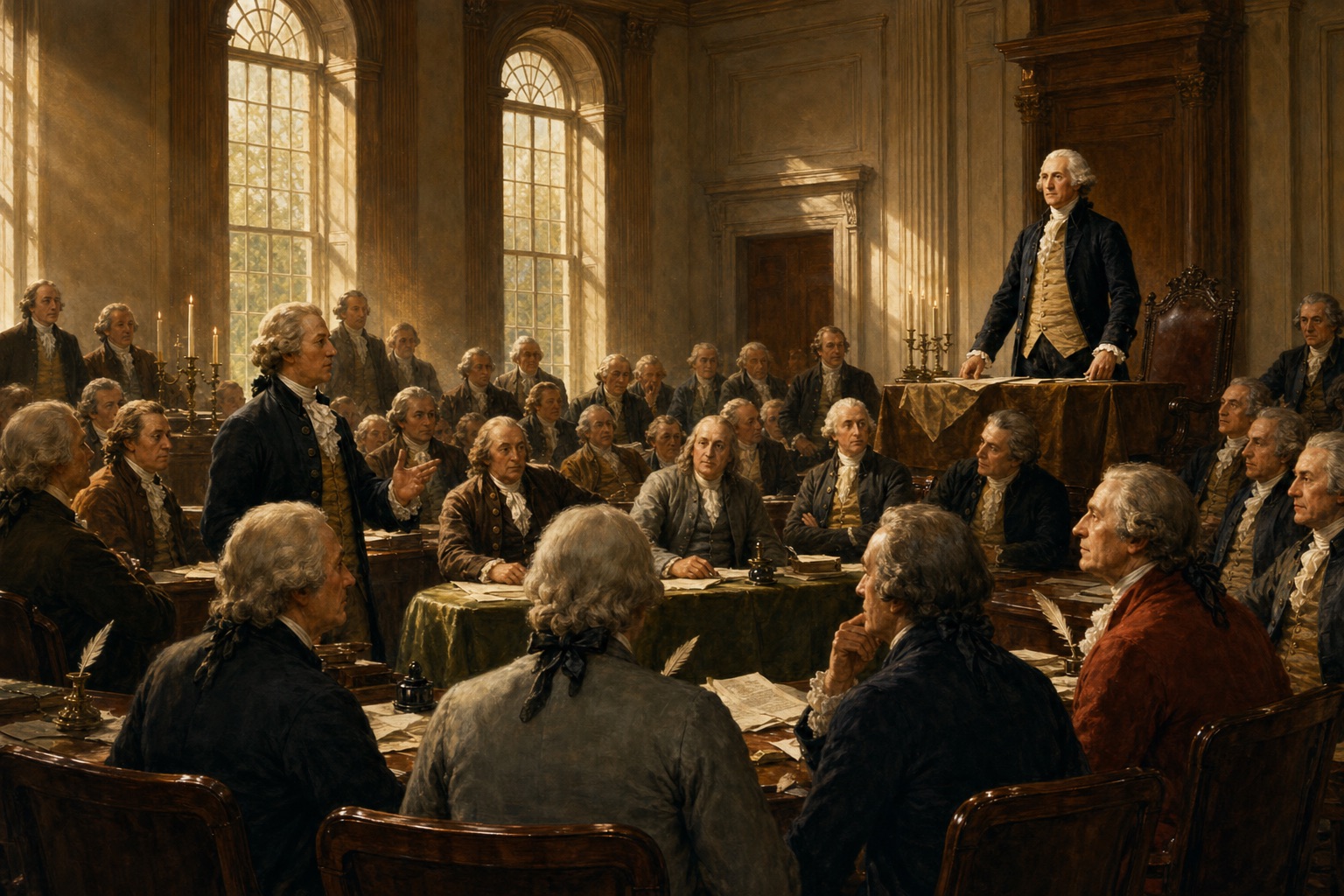
Eventually, the war was won, but after independence, the Founders faced the equally difficult task of deciding what kind of nation they had just created. Drafting the Constitution required compromise, debate, and enough caffeinated tea to power a small village. The Bill of Rights, while not a part of the original plan, was added later—James Madison himself initially thought it unnecessary—but public pressure and political reality eventually won the day.
And so, a government was founded based on a Constitution, a Bill of Rights, and a three-way check on power that included a Senate, House of Representatives, and a Judicial System.
But the courage of the Founders was only the beginning. Every generation since has had to defend the freedoms they established. We endured a Civil War and two World Wars, not to mention Korea, Vietnam, and seeming countless battles involving the Middle East. I regress by mentioning that my father fought in World War II, and after reading more than seventy-five books on the subject, I gained a deeper appreciation for what he endured. My brother also served as an Army Ranger. I did not serve, as the Vietnam War was ending while I was in college, but I hold deep respect for those who have fought to preserve the liberties our early settlers envisioned.
This is why it’s so troubling to see people who seem to despise the country or wish to tear it down from within. Many simply do not understand the historical truths that shaped the nation they now criticize.
Be mindful that the Founders themselves didn’t always agree. Alexander Hamilton and Thomas Jefferson argued so fiercely that if social media had existed in 1790, the two of them would have shut down the internet. But their nonviolent debates—along with Madison’s evolving views—helped shape the Constitution into a document flexible enough to endure centuries of change.
None of these men fully understood what they were building. It truly was an experiment—one that had never been attempted before. Many Americans, including myself, believe the hand of God guided the process, and whether one agrees or not, the results are undeniable: a nation that became wealthy, productive, and influential across the world.
I close by suggesting that younger Americans should spend a little more time studying the fascinating history of the great American experiment and a little less time criticizing the sacrifices of those who have given us the opportunity to live free, enjoy life, and engage in the pursuit of happiness. And perhaps, spend a little time with older Americans who have come to appreciate the blessing of the God who gave us the American way.